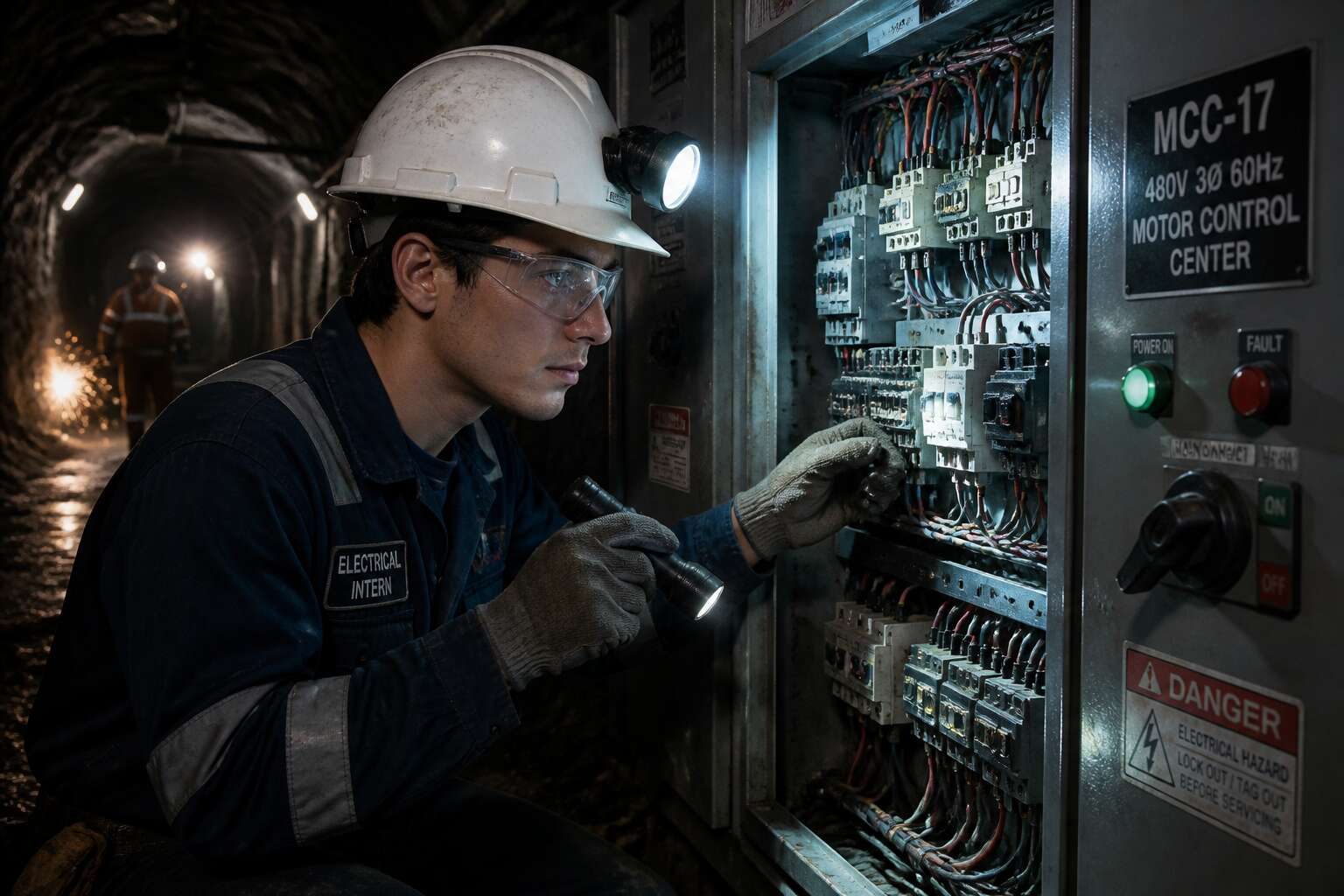
Why Mining Environments Demand Specialized Electrical Engineers
High-Voltage Systems and Underground Power Distribution
South Africa’s deepest mines drop more than four kilometers below the surface. At that depth, the air temperature can exceed 50 degrees Celsius, and every fan, pump, and hoist depends on a continuous power supply. Mining operations do not hire general electricians; they hire engineers who understand high-voltage systems under extreme physical constraints.
Electrical engineering internships in mines expose graduates to a reality that classroom projects never replicate. Underground power distribution runs through tunnels that shift, flood, and corrode. Cables must handle voltage levels that would destroy standard industrial equipment, while circuit protection must account for explosive gas environments and restricted access.
Specialized knowledge covers load calculations and practical concerns:
- Power reticulation in narrow, rock-bolted tunnels
- Earthing systems designed for high resistance ground
- Fault detection in networks that stretch for tens of kilometers
Only those who train on site learn to read these systems. Mining engineers who master these conditions carry practical knowledge that credentials alone cannot provide.
Strict Safety Codes and Regulatory Compliance
Every year, mine safety auditors flag thousands of electrical deviations across South African operations. Most trace back to engineers who never learned the regulatory language underground. Electrical engineering internships in mines exist to close that gap.
The Mine Health and Safety Act and SANS 10292 demand more than codebook reading. I have watched interns stumble over permit to work systems because classrooms cannot teach the responsibility behind a live signature. The daily compliance duties multiply:
- Interpreting gas zoning classifications for each working section
- Certifying flameproof enclosures before energisation
- Documenting isolation procedures for mandatory audits
A rushed approval can pause production, or worse, cost a life. This is why mining environments demand specialised electrical engineers. Generalists know theory. Mining engineers know the legal and physical consequences of every connection they approve. Strict safety codes and regulatory compliance become instinct through electrical engineering internships in mines.
Automation, Remote Operations, and Smart Mining
I have watched South African control rooms evolve from switchboards to command centres. Deep-level mining now runs on control loops and telemetry. A single remote operations centre can manage hoisting, ventilation, and ore flow across multiple shafts. The digital layer is as critical as the copper cable. Engineers must integrate automation systems that tolerate dust, movement, and temperature swings.
Smart mining depends on specialised electrical engineering skills. Programmable logic controllers, SCADA interfaces, and industrial network protocols drive modern mines. An engineer who understands these systems can isolate faults without halting production. That skill arrives through electrical engineering internships in mines, where theory meets the rock face. Interns learn to:
- Commission fault-tolerant networks for autonomous haulage
- Tune control loops for underground pumping systems
- Debug remote telemetry feeds from working sections
Generalists read schematics. Mining electrical engineers read a network topology and a geological survey with equal fluency.
The Role of Electrical Engineers in Mine Electrification
Few industrial settings punish electrical systems like a South African mine. Heat, moisture and rock movement work against every component. A standard commercial installation fails within weeks. The environment itself demands a specialised engineer.
Mine electrification is accelerating. Diesel fleets are giving way to battery-electric loaders and trolley-assisted trucks. This shift requires engineers who understand traction converters, charging infrastructure and regenerative braking. They must balance limited power underground while keeping production moving. A single power spike can stall a shaft for hours!
This is where electrical engineering internships in mines matter. They build the mindset generalists lack, the ability to understand an entire system, from the strata to the schedule. Interns who master this early carry that perspective into their careers.
What to Expect During an Electrical Engineering Internship at a Mine Site
Daily Responsibilities and Tasks of an Intern
Electrical engineering internships in mines are misunderstood. Most people picture an intern fetching tools, but that impression fades on your first Monday. You receive a torch, a test meter, and a permit to work alongside the crew. Your daily rhythm follows machine condition, not office hours.
The day starts with a planning session. Then you move into the field. You might assist with fault-finding on trailing cables, verify protection settings, or measure insulation resistance before reconnection. Every task gets recorded and signed off. The paperwork feels relentless, but it teaches accountability.
- Inspecting cable terminations for wear or moisture
- Updating single line diagrams after equipment changes
- Preparing isolation certificates under supervision
These electrical engineering internships in mines ask you to think in sequence. Switching the wrong breaker has consequences for the entire shaft. Interns also spend time in the workshop, dressing cable ends and testing earth continuity on refurbished components. Repetitive, yes, but it builds an intuitive sense of how current travels through rock and steel.
Working Alongside Senior Electrical Engineers
Shadowing a senior engineer during electrical engineering internships in mines means watching someone read a mountain of data and make a call that shifts an entire shift’s priorities. The mentorship is direct. You stand beside them during fault diagnostics, learning how they interpret the subtle hum of a transformer or the slight heat signature on a switchgear panel.
Senior engineers do not spoon-feed answers. They ask questions about your reasoning, then correct the sequence of your thinking. A typical afternoon might involve:
- Reviewing relay coordination curves with the protection specialist
- Walking the haul road to inspect cable routes before blasting
- Debating the merits of a soft starter versus a variable speed drive in a dusty environment
The value lies in observing their hesitation. I noticed when they paused before approving a reconnection, and I learned that hesitation is a tool, not a weakness. These electrical engineering internships in mines turn theoretical knowledge into judgement.
Hands-On Exposure to SCADA and PLC Systems
SCADA screens in mines are not the glossy dashboards vendors show at trade shows. They are cluttered, beeping, and occasionally wrong. During electrical engineering internships in mines, I spent my first week just learning which alarms mattered and which ones had been ignored since 2019.
PLC work is more tactile. You will trace ladder logic, fault inputs, and argue with a conveyor that insists it is jammed when it is clearly not. In one instance, a sensor had been cable-tied to a pipe for years. That pipe vibrated. The sensor did not!
Expect to:
- Download and interpret PLC programs under supervision
- Tag and verify field instruments against SCADA points
- Watch process control loops behave strangely in real time
This is the reality of a dusty control room in Rustenburg. The satisfaction of finding a misconfigured analog input is real. The bruises from crawling under control cabinets are also real.
Rotational Placements Across Mining Departments
Rotational placements move you across departments with little warning. You spend two weeks with the conveyors, two weeks with the winders, and two weeks with the battery electric vehicle team, just enough time to learn everyone’s names before relocating. For electrical engineering internships in mines, this rotation reveals which department hates its equipment the most.
You will see:
- Processing plants where motors run until they smoke
- Underground workshops with cables that defy every colour code
- Surface operations arguing about standby generators
Each move teaches a new failure mode. You leave with scar tissue and a mental map of the mine’s electrical skeleton.
Interpreting Single-Line Diagrams and Blueprints
Most interns arrive at a mine thinking they will touch wires. Instead, they spend their first week staring at single-line diagrams. These drawings show every transformer, breaker, and cable from the surface to the stope. A misinterpreted symbol can send you to the wrong switchgear, which is how accidents happen.
During electrical engineering internships in mines, blueprint reading is a core task. You will trace circuits from the main substation down to the pump motor. You will check revision dates because outdated drawings cause real harm.
- Missing neutral returns on motor control centres
- Protection relay numbers that do not match the panel
- Cross-referencing cable schedules with the actual physical route
The most useful interns annotate every drawing they touch. They ask senior staff why certain connections differ from the standard. They leave behind a cleaner record than they found.
Mandatory Health, Safety, and Hazard Training
Mandatory health, safety, and hazard training rewires how you see the mine. You spend days in a simulation bay with false threats on the walls.
Your instructor asks you to identify the escape route with your eyes closed. That feels absurd until you remember that smoke removes your sight first.
For electrical engineering internships in mines, this training is the foundation. It is not a formality. It is a sequence.
You practice sealing a refuge bay. You learn to distinguish rattle of a roof fall from hiss of a hydraulic leak.
A list of competencies for electrical engineering internships in mines sits in your pocket:
- Check pressure gauges on the self rescuers.
- Verify the emergency stop on conveyor drives.
- Walk the gob edge to confirm gas barriers.
- Report every missing rubber seal.
By Friday, you know that safety is not a separate task. It is the way to work.
Key Skills and Qualifications Employers Look For in Mining Interns
Strong Foundation in Power Systems and Circuit Theory
Interviewers for electrical engineering internships in mines scan for a demonstrable command of circuit theory. A strong foundation in power systems separates a capable intern from a liability. I have watched technical panels ask pointed questions about reactive power and fault impedance during the first screening, expecting rigorous answers on the spot!
Employers want to see precise understanding of these fundamentals:
- Three-phase balanced and unbalanced loads
- Thevenin and Norton equivalent circuits
- Transformer and motor starting characteristics
Without this base, advanced software and relay settings remain abstract. For electrical engineering internships in mines, this foundational knowledge is the core prerequisite. It allows you to contribute to load flow studies and protection coordination from the very first week. A grip of both continuous and transient states ensures you can model the behaviour of a 6.6 kV ring main before you ever touch a live terminal.
Understanding of Variable Speed Drives and Motors
Variable speed drives power the ventilation fans and conveyor belts that keep South African mines operational. Employers evaluating candidates for electrical engineering internships in mines look for a working knowledge of drive topologies, from V/f control to field-oriented control. They expect you to explain how a soft starter limits inrush current, or why a slip-ring motor behaves differently under load.
A capable intern reads a motor nameplate and calculates full-load current without hesitation. They distinguish between squirrel-cage and wound-rotor induction motors, and recognise when a synchronous motor is the better choice.
I have seen competent engineers fumble this exact subject during screening. Misconfigured drives create harmonic distortion and mechanical stress on rotating equipment. Hands-on familiarity with VSD parameters, such as ramp times and torque limits, carries real weight in the selection process.
Problem-Solving and Troubleshooting in Remote Settings
The deepest shafts in South Africa are places where a single blown fuse can idle an entire shift. For anyone pursuing electrical engineering internships in mines, problem-solving in these conditions is about composure as much as knowledge. When a substation trips at the end of a two kilometre tunnel, you cannot phone for a second opinion. You carry the tools, the drawings, and the responsibility for a stalled production cycle.
I have watched capable interns freeze when a fault box goes silent. Employers notice. They look for:
- Systematic isolation of a fault before touching a terminal
- Clear communication to a shift boss who is losing revenue by the minute
- The judgement to escalate before making a bad situation worse
That judgement is the difference between a useful intern and a liability.
Familiarity with Mining Equipment and Instrumentation
Employers in South African mining operations expect interns to arrive with more than theory. Familiarity with mining equipment and instrumentation separates candidates who need supervision from those who can support daily production. I have seen interns lose credibility by misidentifying a pH sensor for a flow transmitter, a small error that costs trust from the crew. For electrical engineering internships in mines, the practical baseline includes tracing a signal from a rotating drum to the control room.
Employers look for demonstrated competence in these areas, and candidates for electrical engineering internships in mines should verify each one:
- Identifying cable gland sizes and termination types without a manual
- Interpreting instrument loop diagrams and wire numbers on live panels
- Understanding the difference between 4 20 mA loops and digital fieldbus signals
- Recognising normal vibration, heat, and noise signatures on motors and gearboxes
Communication Skills for Cross-Functional Teams
Mining communication rarely happens in a quiet office. It happens near a vibrating screen, with a supervisor shouting over the noise. For electrical engineering internships in mines, speaking clearly across disciplines changes how supervisors evaluate you. I recall an intern who diagnosed a variable speed drive fault but could not explain it to the section engineer. That failure cost him credibility.
Cross-functional teams include rock engineers, production planners, and safety officers. You must adjust your vocabulary for each audience. Employers expect you to manage these practical situations:
- Summarising a fault in under two minutes for a shift handover
- Writing a work order that another artisan can execute without further clarification
- Escalating safety risks without causing panic or delay
These communication skills are not optional. They determine if you become a trusted engineer or a liability. For electrical engineering internships in mines, every interaction is an evaluation.
How to Land an Electrical Engineering Internship in the Mining Sector
Tailoring Your Resume with Mining-Relevant Keywords
Each year, South African mining houses receive hundreds of applications for every internship vacancy. Landing one of the sought-after electrical engineering internships in mines demands more than a generic CV. Applicant tracking systems scan for specific terms, and a resume without them never reaches a human reviewer!
Tailoring your application starts with the language of the industry. Headings such as ‘Mining Project Support’ and ‘Underground Electrical Maintenance’ signal relevant experience. The experience section should name specific software and standards.
A strong keyword block might look like this:
- Mining-specific CMMS platforms such as SAP PM
- Electrical drawings for mineral processing plants
- Compliance with MHSA regulations
- Asset condition monitoring and predictive maintenance
Successful applicants pair each keyword with a tangible achievement. One candidate wrote ‘Reduced downtime by logging 40 work orders in SAP PM’ instead of a generic phrase. For electrical engineering internships in mines, that approach signals a deeper understanding of the operating context.
Building Connections Through Industry Events and Job Fairs
The mine’s hum is constant. The crowded hall of an industry event carries a similar energy, one that draws recruiters and students into close quarters.
At job fairs, the engineers who hand out brochures are the same ones who sign off on electrical engineering internships in mines. They remember faces, not file names. A single exchange can outlast a hundred applications.
- Ask about their current underground power projects.
- Mention your willingness to shadow a shift supervisor.
- Follow up with a hand-written note.
The crowd thins by late afternoon. That is when the real conversations begin, the ones that lead to a call in the dark of a Monday morning.
Leveraging University Partnerships and Co-op Programs
University partnerships operate quietly behind the faculty noticeboard. In South Africa, mining companies sponsor research chairs and laboratory equipment at engineering universities, and these connections feed directly into electrical engineering internships in mines. A professor overseeing your final year project may sit on the same industry advisory board as a mine’s electrical engineering manager.
Co-op programs make the link explicit. Many South African universities run structured work-integrated learning agreements with local mining operations, where your academic calendar alternates between coursework and paid placements inside active mine sites.
- Mining houses with research chairs at your faculty
- Faculty members who advise mine electrification projects
- Co-op offices holding pre-negotiated placement agreements
These channels activate before any public application portal opens, because the relationship already exists on paper and in person.
Preparing for Technical and Behavioral Interview Questions
An interview for electrical engineering internships in mines rarely follows a script. You might be handed a single-line diagram and asked to spot a protection coordination flaw, then asked how you once handled a conflict with a team leader. Both answers carry weight, but they are judged differently. In my experience, panel members notice when a candidate tries to bluff through a technical gap.
Technical readiness means revisiting fault level calculations, relay settings, and cable insulation classes. Review your final year project and the lab work you did with variable speed drives. If you do not know a value, say so. Mining engineers respect a candidate who will open a standard instead of guessing.
Behavioral questions dig into your response to pressure. The panel wants to see how you act before, during, and after an incident. Typical questions include:
- Describe a time you reported a near miss and what you learned from it
- How would you respond if a supervisor asked you to skip a lockout step?
- Tell us about a time you explained a technical issue to a non-engineer
Preparing for electrical engineering internships in mines means doing both kinds of homework. Know your machines and know your own limits.
Applying Directly to Mining Companies vs. Third-Party Recruiters
Most mining houses in South Africa advertise vacancies through their own portals first. A direct application gets your CV in front of a hiring manager who understands the mine’s specific power distribution needs. Third-party recruiters, by contrast, filter candidates for multiple sites. They offer speed but can lose the nuance of your technical background.
For electrical engineering internships in mines, the smart approach is to use both channels. Direct applications work well for large names like Anglo American or Sibanye-Stillwater. Recruiters help you reach smaller operations that lack internal HR teams. Keep your documents identical for both routes. Update your profile after each rejection or interview.
Timing Your Application for Peak Hiring Seasons
Every mining house in South Africa runs on a recruitment calendar that mirrors its budget cycle. For electrical engineering internships in mines, the practical application window stretches from April to September, with the highest volume of postings appearing between May and July. The reason is financial. Training budgets for the following year get locked in during the third quarter, and intern intakes are sized against those numbers.
Different commodities move at different speeds. Platinum and gold operations publish early, often before the academic winter recess. Coal and chrome producers hold back until August.
- April: early postings from major houses
- May to July: peak volume on mining portals
- August to September: late openings from smaller operators
Submissions during the early surge get reviewed while budgets remain flexible. October submissions for electrical engineering internships in mines enter a slimmer field, competing for the few remaining slots.
Career Progression from Mining Internship to Full-Time Engineer
How to Convert Your Internship into a Graduate Role
Most interns assume technical brilliance is enough. The shift from intern to graduate engineer depends on relationships and ownership of tasks. A supervisor who trusts you to work independently will advocate for your permanent appointment.
Ask for a structured debrief midway through your placement. This signals seriousness and gives you time to correct course. I have seen interns lose out because no one could see their progress. Volunteer for projects others avoid, especially equipment testing or data collection. Willingness to handle gritty work determines how senior engineers remember you.
- Respond promptly to senior engineers
- Document each troubleshooting step
- Show genuine curiosity about the whole mining operation
These behaviours build a reputation. When a graduate role opens, that reputation becomes your de facto reference. Electrical engineering internships in mines that convert into job offers share this pattern: consistent effort, visible progress, a supervisor who backs you internally.
Moving Up to Junior, Senior, and Lead Engineer Positions
Starting with electrical engineering internships in mines gives you a vantage point that classroom theory cannot replicate. You see the full arc of a project, from fault finding to commissioning.
The progression to full-time engineer follows a clear path. Junior engineers handle testing and documentation. They learn to prioritise safety without slowing production.
- Junior engineer: master the equipment and build trust with operators.
- Senior engineer: own complex failure analysis and mentor new interns.
- Lead engineer: align electrical strategy with mine planning and financial targets.
Each stage demands a different kind of courage. The junior must admit what they do not know. The senior must delegate. The lead must make decisions when information is incomplete. That is the real career progression, and it starts with the humility you practice as an intern.
Specializing in Automated Haulage and Digital Mining Systems
The transition from an intern to a full-time engineer in automated haulage begins with understanding that trucks are no longer just machines. They carry gigabytes of telemetry every shift. Your electrical engineering internships in mines place you beside the very systems that turn raw data into dispatch decisions.
Early exposure to digital mining systems reveals the real hierarchy of skills:
- Reading the network architecture that connects onboard controllers to central fleet management.
- Understanding sensor calibration and how a faulty encoder stalls an entire circuit.
- Mapping the handover points where human operators yield control to autonomous mode.
Engineers who master these layers become the people mine managers call when production dips. They fix faults and redesign the interface between power systems and data flow. That is the career progression automation promises.
Pursuing Professional Engineer Licensure and Certifications
In South Africa, the journey from intern to professional engineer typically takes three years of mentored experience. Electrical engineering internships in mines offer the structured exposure that makes this transition possible. You start by documenting every fault you diagnose and every circuit you test.
The Engineering Council of South Africa requires a formal logbook and competency reports. Your internships become the evidence you present. Many graduates pursue additional certifications in explosion protection or mine power distribution to strengthen their applications.
One practical observation: engineers who treat their internship paperwork as a professional portfolio, rather than a chore, move through registration faster. Those who wait until the end to reconstruct their experience often stall. The discipline of recording your work weekly pays off at the review panel. That habit separates the candidates who register smoothly from those who scramble.




0 Comments